

Workforce Excellence with AI:
This is how the shop floor is made fit for the futureFounding2021
HEADQUARTERHeroldsberg, Nürnberg
IndustryIT and software services with a focus on industrial applications & training
Whether it’s new processes, occupational safety, or the proper operation of machinery – training is indispensable in production. To ensure optimal learning without interrupting operations, Augmented Industries relies on artificial intelligence (AI). The training sessions are seamlessly integrated into everyday work. For this innovation, the start-up was awarded the prestigious WECONOMY Prize. In this interview, Dr. Elisa Roth, co-founder and CEO of the company, explains the benefits of this new form of knowledge transfer.
About the company
Augmented Industries was founded in 2021 by Dr. Elisa Roth and Dr. Mirco Möncks. Their Workforce Excellence solution uses AI to generate training and worker guidance, delivering them directly in everyday operations. The goal is to efficiently and needs-based qualify employees in production, enabling the workforce to be deployed more flexibly for complex tasks.
Ms. Roth, how does Augmented Industries use AI in corporate training?
With the help of AI, we transform existing content – such as work instructions, safety regulations, or operating manuals – into interactive digital microlearnings, skill checks, or step-by-step guides. These are short, practice-oriented, and can be repeated by employees at any time. They are based on real work processes and enable individual learning at one’s own pace. In traditional training sessions, employees are often pulled out of the process. They are taken off the line to attend a seminar. This costs time and often leads to the learned material being quickly forgotten.
Is learning easier with the digital microlearnings?
Compared to traditional methods such as classroom training or reading through work instructions, our approach is significantly more sustainable. As a result, employees feel much more confident and competent when dealing with new tasks or machines, which is particularly important for quality-relevant training.
What percentage of the training content can be delivered digitally?
Our research shows that around 70 percent of knowledge transfer in the areas of production and maintenance can already take place digitally. The rest must be trained hands-on within the process. However, digital support is not only possible but also indispensable in view of the severe shortage of trainers – especially in plant engineering.

70% Digital
Knowledge transfer in production and maintenance.
Is the 70 percent limit fixed or flexible?
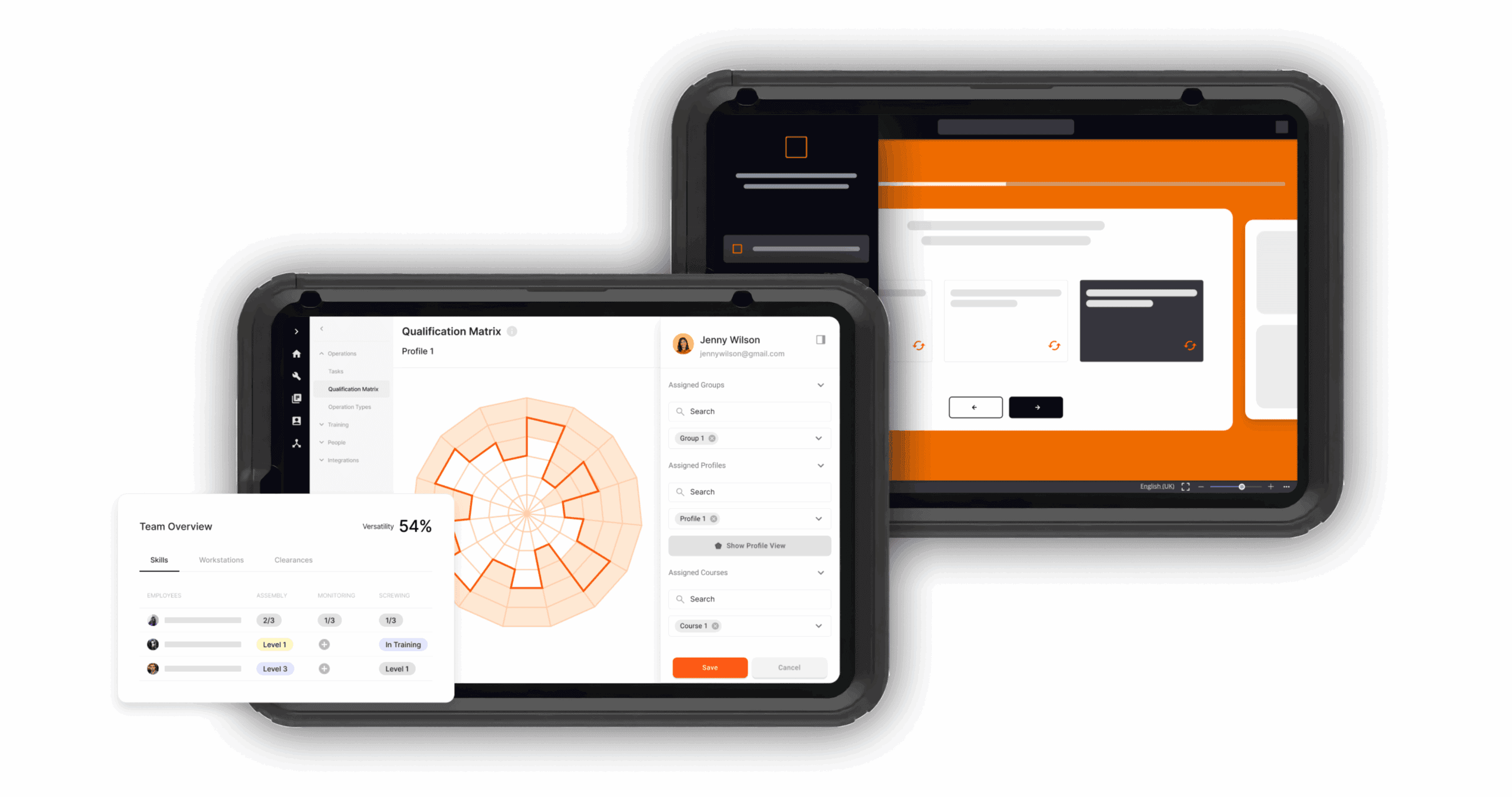
This limit will continue to shift. Thanks to new augmented reality elements, technology will be able to provide even better support in the process in the future. Even today, we use intelligent knowledge graphs to extract tasks and roles from work instructions and create a process map that identifies qualification gaps and generates automated learning paths. In this way, we automate the process from training needs through creation and implementation to the automatically generated certificate.
What about data protection in digital learning?
Our systems are ISO/IEC 27001 and ISO 42001 certified and therefore meet the highest standards for information and AI security. All data is processed and stored on servers in Germany, ensuring compliance with the GDPR. Customers such as Siemens, BMW, and Ford already place their trust in our solution.
How can companies measure the economic benefits of their application?
We aim for a payback period of six to nine months, which corresponds to the current investment cycles for software. In many cases, payback is already achieved after a single project, for example after a line relocation, a larger onboarding, or the introduction of a new process. Profitability is based on three main factors:
• First, we significantly reduce the opportunity costs of training, since employees no longer have to be released for classroom training but can complete short, effective learning units during downtime.
• Second, we minimize the costs for external trainers, as subject matter experts and process engineers can create training themselves with the help of our AI – and about ten times faster than before.
• Another advantage is seamless training documentation through precise audit logs. In addition, continuous improvement cycles are significantly shortened: while the implementation of process changes previously required four to eight weeks, now all employees are informed and trained within a single day.

How is your motto ‘Empowering people, transforming manufacturing’ reflected in everyday life within companies?
Our motto is based on the proven Lean insight that empowered employees are drivers of productivity. True transformation depends on their flexibility – both in their mindset and in the tasks they master. Our solution enables employees to continuously develop their skills, even without traditional classroom formats. It strengthens their willingness to embrace change and supports the development of future-oriented competencies in everyday work. This creates a learning organization that can respond to change with flexibility and resilience. Employees can look up information themselves or consult the AI before having to turn to their supervisors. In this way, we give them confidence in times of change – a crucial factor for successful transformation processes.
What will industrial training of the future look like?
By 2030, we will be able to interact with machines and processes in natural language – with the help of AI agents that continuously provide us with new knowledge. This collaboration between humans and technology is a model for success, as peer learning and self-experience are the most effective learning methods. However, complex assembly, maintenance, and customer service tasks will remain in human hands in the long term – a good outlook for strong tandems of humans and AI.

Dr. Elisa Roth is co-founder and CEO of Augmented Industries. Her motto: Appreciation for value creation. After studying Industrial Engineering & Management at TU Darmstadt, she completed her PhD at the Institute for Manufacturing at the University of Cambridge on the topic of worker assistance systems.Dr. Elisa Roth
CEO, Augmented Industries GmbH
Printausgabe
Magazin Order
The focus of our magazine is on success stories that show how companies are meeting these challenges in order to remain future-proof in their competitive environment. Our articles come from customers, partners, and colleagues who share their practical experiences with us.

This might also interest you:

Study Digitalization
The Staufen study “Digitalization 2024” shows how difficult it is to exploit the full potential of data. The study underlines the need for a data-driven strategy and professional data analysis and points to a lack of expertise, resources and a data-centric corporate culture.
Read more
REQUEST THE MAGAZINE NOW AS A DIGITAL VERSION OR PRINT EDITION
