

With more and more effective leadership to higher productivity
In brief
Top executives don’t fall from the sky, but they can sustainably develop to a much higher level in a short time. This pays off not only for the leaders themselves but also for the employer, who wants to increase competitiveness through higher productivity. The story of ELESTA shows how coaching a few team members systematically enables the entire organization to move to a new stage of development.
How ELESTA, through KPI-driven coaching, enhances the performance of the leadership team in the relay department, increases improvement activities, and thereby boosts productivity by 6 percent.
Eight leaders and multipliers receive shop floor management coaching (SFM coaching). In the end, an already progressive company transforms into an organization of thinkers and doers like no other, managing, among other things, to increase productivity by 6 percent. A small investment, considering the outcome. But let’s start from the beginning.
Let’s begin at the very heart of ELESTA: the company’s DNA. For there we find the nucleus that made this success story possible – ELESTA’s self-concept of Lean Management and the special role of its employees: “We have a very strong ‘just do it’ mentality. We question a lot and always want to improve. For us, Lean is not a project, it is part of our culture. Our employees play a key role in this. Because each and every individual in the company may – and should – be an independent thinker and improver. We create the necessary space for this,” explains Sebastian Schiemenz, Head of Strategic Organizational Development at ELESTA.

Sebastian Schiemenz
Head of Strategic Organizational Development, ELESTA GmbH

Toni Walser
Head of Production Relays, ELESTA GmbH

Marcel Mettler
CEO, ELESTA GmbH

Amire Destani
Production Team Leader, ELESTA GmbH
Shop Floor Management Coaching: With targeted leadership toward greater accountability and efficiency
To further improve this environment, Toni Walser, Head of Production Relays, proposed to ELESTA CEO Marcel Mettler in 2023 to conduct SFM coaching. Why coaching in particular? Having recently joined ELESTA, Toni Walser had already gained experience with leadership coaching in his previous roles. His reasoning was convincing: “Of course, I could send my managers to external training for days. But during that time, they are not here with their team, and the benefit is much lower. It is a major challenge to implement what has been learned effectively and sustainably without a coach.”
Dominik Bühlmann, one of our senior experts from Switzerland, then developed a coaching concept specifically tailored to the team at ELESTA. At its core, it was about systematically enabling managers to encourage and demand accountable action from employees. Another goal was to support the team in introducing clearer structures and aligning the existing improvement culture with the optimization of their own shop floor KPIs.
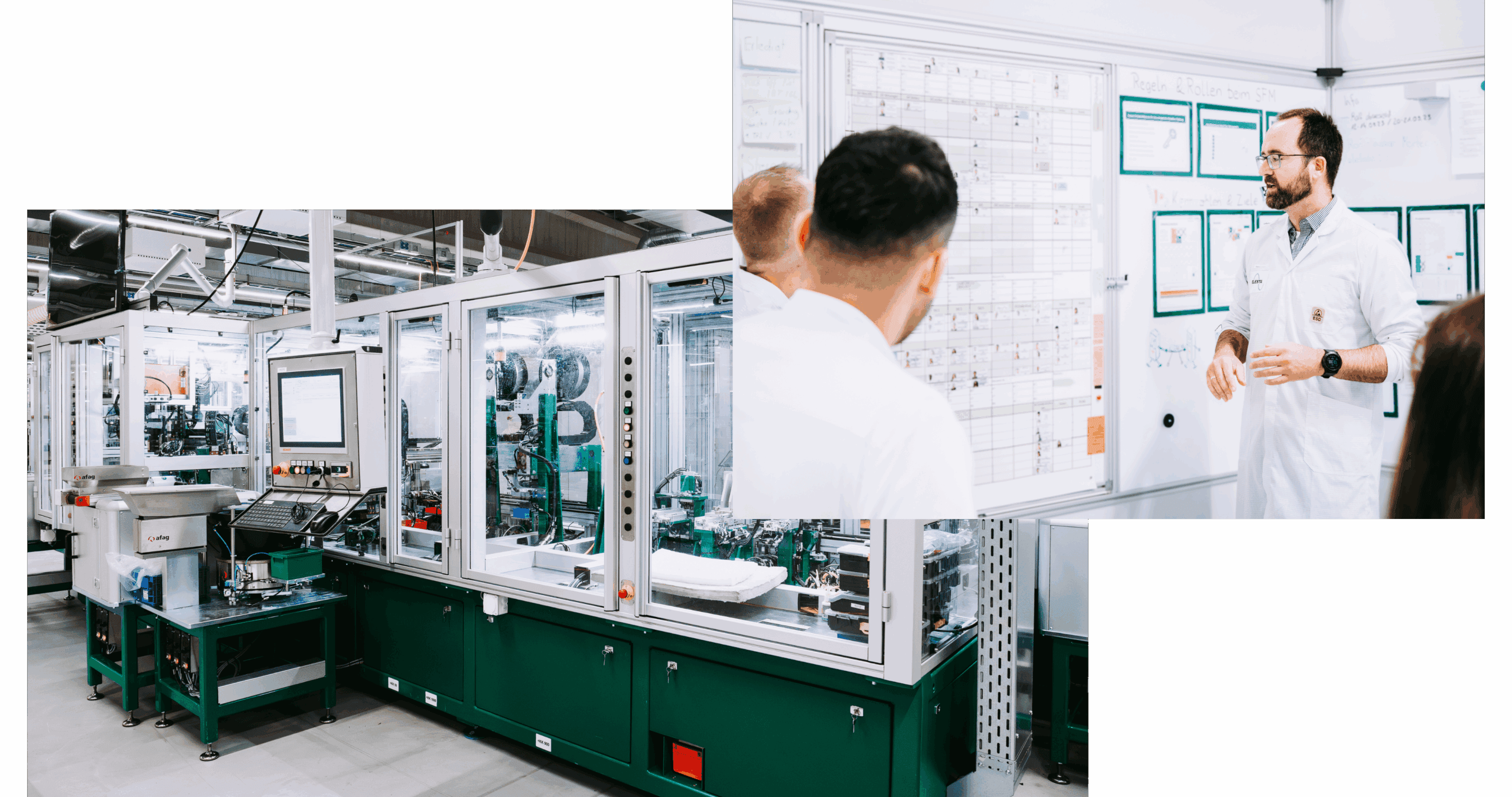
To make this possible, managers had to engage intensively with themselves, their current processes and structures, as well as their communication. The clearer everything is, the more efficient production becomes and the better everyone can respond to unplanned events. For three quarters of a year, Dominik Bühlmann worked with the coachees on their challenges and on consolidating the methods learned, such as questioning techniques and structured problem-solving.
With more and more effective leadership to higher productivity
Sebastian Schiemenz is enthusiastic: “At the core, what has changed is that the managers in this department are no longer the ones putting out fires every day, but those who enable the team, through clear structures and roles, to actively solve problems themselves. Today, production employees have more space to contribute improvements and try things out on their own. The managers, in turn, now have the capacity to truly lead their employees and think strategically about the future.” This capacity, in addition to the increased quality of leadership, is another success factor. “Through the improved quality and quantity of leadership, productivity and team satisfaction have increased significantly,” concludes Sebastian Schiemenz.
In times of an increasing shortage of skilled workers, coaching can also be a compelling benefit for employees. Amire Destani, Production Team Leader, tells us how valuable the coaching was for her personally: “I have become more self-confident and feel much more secure in my role as a manager. My employees notice that, too.” Thanks to the coaching, she succeeded in really applying the methods learned to her individual challenges, reflecting on herself more effectively, and involving her team more clearly. Even privately, she has benefited a lot from the coaching.
In the relay department, both course and morale are right. But what about the KPIs? Can the benefits of coaching also be expressed in numbers? “That is difficult,” says CEO Marcel Mettler, “because there are always many parallel developments inside and outside the company.” If you compare the hours worked to the output achieved, one year after the start of coaching you arrive at an output increase of around 6 percent. Coaching contributed significantly to this. Thanks also to the completely revised shop floor management system: already during the coaching, the 8 coachees implemented an average of 20 improvements and problem solutions per month. One year later, this number has even increased to 30. The implementation time of the measures has also since been reduced by 8 to an average of 22 working days. Mettler is convinced of the coaching: “We will continue. Other departments are already waiting in the wings and can’t wait to receive coaching themselves.”
Increasing competitiveness through coaching
Dominik Bühlmann
Dominik Bühlmann hat langjährige Erfahrung als interner Lean Experte und Berater zum Thema Lean Transformation und ist Experte für das Thema Shopfloor Management und Führungskräfte-Coaching. Er besitzt umfassende Projekterfahrung in den Bereichen Administration, Auftragsabwicklung und Montage, ist ein erfahrener Trainer mit Fokus auf die ganzheitliche Befähigung von Organisationen und Leiter der Akademie der Staufen.Inova.
Dominik Bühlmann,
Senior Expert, Staufen, part of Accenture
Our senior expert from Switzerland, Dominik Bühlmann, designed and carried out the coaching project for ELESTA together with the coachees. In this conversation, he explains why coaching is so valuable for companies.
Dominik, it is very important to you to draw the attention of decision-makers to the potential of leadership coaching. Why?
Coaching currently plays hardly any role in companies in the context of performance improvement. Yet projects like the one with ELESTA show what forces coaching can unleash. My experience is: you can certainly optimize a production line physically, but if you enable employees to actively shape this optimization process, then it really becomes effective. For any kind of sustainability, you need managers who can truly lead. With coaching, you can meet each manager where they are, address their specific challenges, and individually empower them to achieve the intended goal.
How can coaching contribute to the future viability of companies?
Coaching is a huge lever for continuous improvement. Anything a company produces can be copied. What cannot be copied is the way an organization solves problems. Those who want to survive must master the art of solving problems as structurally, quickly, and sustainably as possible. For this, you need top-trained managers – and this is where individual coaching comes into play again.
How does coaching influence change processes in companies?
Coaching enables much more agility and dynamism. For the coachee, all ongoing and newly added changes within an organization converge. Through individual guidance and reflection, it becomes possible to connect both, focus, and transfer what has been learned to other challenges. In this way, coaching can have a positive impact beyond the immediate project framework on other projects and on the overall change culture within the company.

About Elesta
Founded in 1952 under the name ELESTA Elektrotechnik AG, ELESTA GmbH develops and manufactures products in the field of relay technology and customized sensors. With 350 employees, ELESTA develops and produces entirely in Bad Ragaz, Switzerland – in a high-wage country. This is possible, among other things, because everyone in the company consistently acts according to Lean principles and because ELESTA sustainably promotes entrepreneurial thinking and action among its employees.
Order magazine
Our magazine focuses on success stories that show how companies are meeting these challenges in order to remain competitive in their environment. Our articles are written by customers, partners, and colleagues who share their practical experiences with us.

You may also be interested in:

Agile Teams at MAN Truck & Bus
REQUEST THE MAGAZINE NOW AS A DIGITAL VERSION OR PRINT EDITION
