
A “perfect match” for the industry:
Why Staufen and Accenture are joining forcesEmployees (Accenture)791.000+
billion in revenue ($)64,9
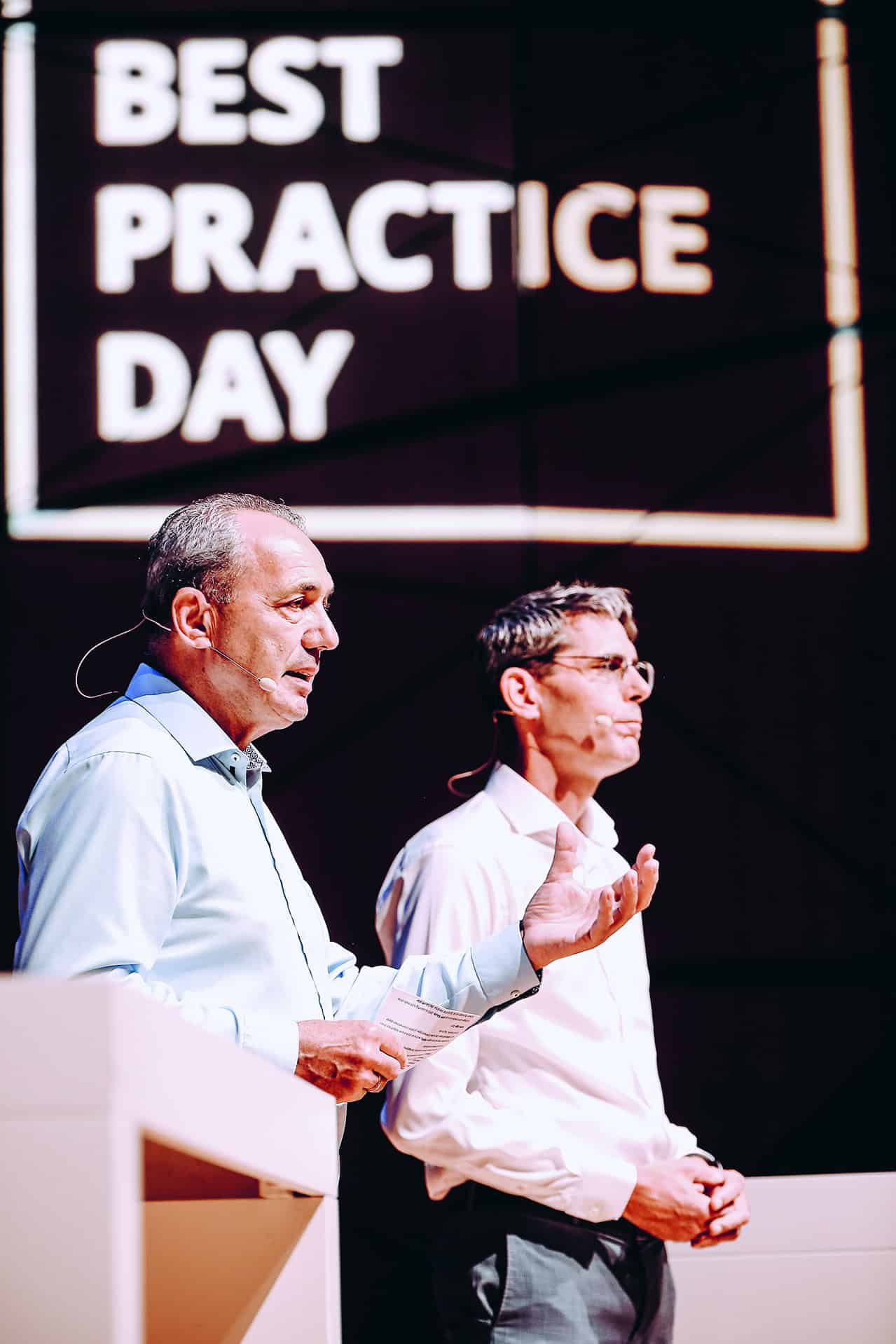
The industry is facing enormous challenges. Digitalization and efficiency are more important than ever. In the interview, Wilhelm Goschy, CEO of Staufen AG, and Matthias Hégelé, Managing Director Supply Chain & Operations DACH at Accenture, explain why the merger of the two companies comes at exactly the right time, what specific added value the new alliance offers customers, and why operational excellence and digital transformation are inseparably linked.
What was the key factor for you in taking this step – why this merger?
Matthias Hégelé: Accenture has outstanding expertise in digitalization, particularly along the entire core value chain. Staufen, in turn, brings deep expertise in production processes and a close connection to industry. The combination of our respective strengths creates enormous leverage: Staufen’s operational excellence know-how meets Accenture’s digitalization expertise. This enables us to jointly realize large, scalable projects that create significantly more value than either partner could achieve alone. In short: the whole is greater than the sum of its parts.
Wilhelm Goschy: The future of industry is digital – there is no way around it. The consulting services that Staufen has been offering for more than 30 years are now unthinkable without digital components. Whether supply chain automation or factory planning: digital twins and simulation models have become indispensable. The partnership with a global technology leader was therefore the logical step. Through the merger, we now have the right technological solutions for our customers – a perfect match.
How does the collaboration work in practice?
Wilhelm Goschy: Accenture complements our traditional strengths in process optimization and employee development with cutting-edge technology expertise. A good example of the combination of Lean expertise and state-of-the-art IT is a current project with an agricultural machinery manufacturer. In addition to increasing efficiency in product development through shorter lead times and optimized interfaces, the project also involves an IT solution for better collaboration between different sites as well as cross-functional deviation management. Another example from the field of digitalization: To make the learning process simpler and faster, a customer wanted 3D visualization of work instructions. Now we can say: We are part of Accenture. There is a team of over 250 people there who do exactly that.
Matthias Hégelé: Another example is a large bakery with around 200 sites. The task is to reduce the product-related costs of goods sold by 20 percent with the help of AI. As experienced production specialists and digitalization experts, we analyze the data flow together along the entire value stream and develop tailored solutions for the complex challenges in production and logistics.
Which new technologies are particularly useful for companies?
Matthias Hégelé: Intelligent agents, so-called AI agents, are increasingly taking on tasks that previously required human decisions. Accenture is a leader in the development and implementation of these technologies. The goal is to automate recurring processes and specifically support decision-making. This allows employees to focus on more demanding tasks, monitor processes, and make complex decisions while routine tasks run automatically. A concrete example: At one of our clients, AI agents with a high degree of autonomy take over large parts of the order-to-cash process. They check orders, monitor availability, suggest alternatives, and provide automated customer feedback – ideal for standardized processes with low margins. In specialized business areas, so-called augmented agents are used, which propose scenarios and perform calculations. Here, humans remain more strongly involved. The technological development is clearly moving in this direction: humans are not being replaced but are given more powerful tools. The result is increased efficiency, improved quality, and shorter innovation cycles – exactly what companies need to remain successful in an increasingly dynamic market environment.
Accenture and Staufen each have their own cultural roots and traditions. How does what belongs together grow together?
Matthias Hégelé: The key lies in lived collaboration. It starts with management but goes far beyond that. We brought the operational teams together early on, because our business is based on relationships and trust. It’s not just about processes, but also about people getting to know each other, building trust, and enjoying working together. To support this, we introduced a buddy system. Accenture colleagues help their Staufen counterparts to find their way within our complex organization – in a straightforward and practical way. In addition, we rely on personal encounters that combine professional exchange and team building. For us, the rule is: structure and culture must grow together.
Wilhelm Goschy: This collaboration is also evident in everyday life. For example, we recently held our monthly CIP meeting at the Accenture Innovation Center in Munich. In a marketplace format, everyone was able to exchange ideas on equal footing and develop solutions together. However, the foundation is the operational collaboration for our customers. Only when real challenges are mastered as a team does a resilient connection emerge.
How have Staufen’s customers reacted to the merger?
Wilhelm Goschy: The response has been very positive. Our customers immediately recognized the added value that the close integration of production know-how and digitalization expertise provides. While Staufen used to be known primarily for operational excellence and lean management, we are now also excellently positioned in areas such as machine learning, the use of digital twins in process and factory planning, supply chain automation, and analytics. Our customers benefit from this – from corporations to family-owned medium-sized businesses. Typical Staufen strengths such as personal commitment down to the shop floor will remain an essential success factor in our work going forward.
Looking ahead: Where do you see the alliance forged now in two to three years?
Matthias Hégelé: Companies are currently under considerable pressure – geopolitically, economically, and organizationally. Digitalization is no longer an option but an absolute necessity, especially in view of the shortage of skilled workers. With our approach of combining operational excellence with digitalization, we create efficiency and open up scope for investments in the future. Staufen’s many years of experience are a key success factor that we want to continue to build on together.
Wilhelm Goschy: We recently visited a customer who is already highly digitalized and extremely efficient today – a true role model for the industry. Our goal is to bring as many companies as possible to this level in the coming years. With the help of process optimization and digitalization, we want to free up resources, eliminate waste, and enable innovation. The potential for this is enormous.
Print
Order magazine
Im Fokus unseres Magazins, stehen Erfolgsgeschichten, die aufzeigen, wie Unternehmen diesen Herausforderungen begegnen, um in ihrem Wettbewerbsumfeld zukunftsfähig zu bleiben. Unsere Artikel stammen von Kunden, Partnern und Kollegen, die ihre praktischen Erfahrungen mit uns teilen.

This might also interest you:
No posts selected.
REQUEST THE MAGAZINE NOW AS A DIGITAL VERSION OR PRINT EDITION
