

Who would have thought?
Why "working more" doesn't get us anywhere in Germany and what this has to do with the Lean movementIn his speech to the German Economic Council, the new Chancellor, Friedrich Merz, initiated a debate about working hours in Germany. The Chancellor highlighted the relaxation of the strict statutory working time regulations as a key point of the coalition agreement. “With a four-day week and work-life balance, we will not be able to maintain our country’s prosperity,” he said to applause from the entrepreneurs and managers present.¹
The outcry from critics followed promptly. The taz newspaper even reported that an hour more (or less) doesn’t matter at all: “Whether this or that statistic, half an hour more or less, is completely irrelevant.”²
And this is precisely where my thoughts begin, dear readers. What is it about? It’s about the difference between work and performance. It’s about the difference between an absolute and a relative quantity. The enraged minds, who quickly cited all the examples of overload from the construction industry, hadn’t really been listening.
The Chancellor also spoke of the need to “work more and, above all, more efficiently.”1
There it is: the keyword efficiency. Still known to many of you as “work smarter, not harder,” this should be understood here: More “work” won’t get us anywhere in Germany. We should think about “performance” again before we get upset about longer working hours.
If we want performance, then the first requirement is to eliminate everything the customer doesn’t want to pay for. “The customer” also includes colleagues, the subsequent process within the company, and, of course, the consumer at the end of the value chain. Thus, unproductive working hours in the office – just to please the boss – will hopefully be a thing of the past.
In the second step, employees structure their processes so that they can achieve their work results within the allotted time. In well-organized work systems, employees work more efficiently.
The proportion of value-adding activities is increased by eliminating waste rather than by increasing performance.
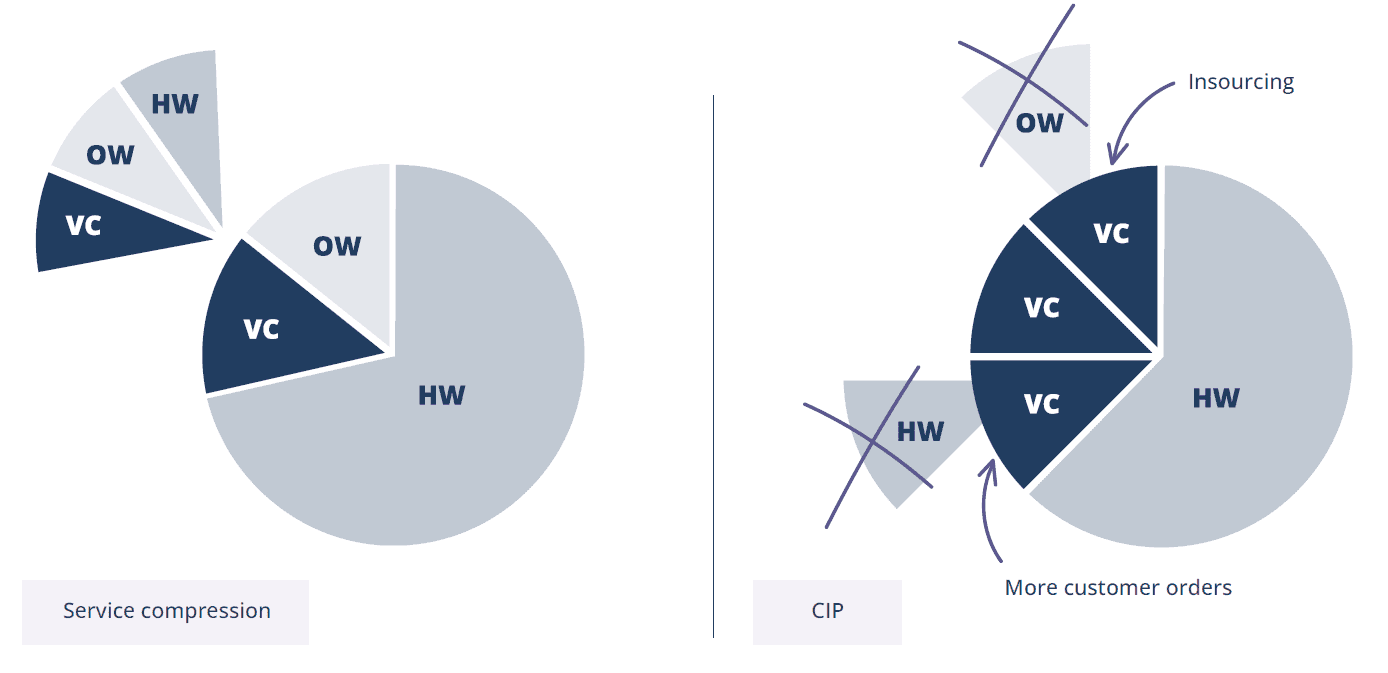
Increase productivity by exchanging waste for added value, not by intensifying work, i.e., “cramming” more work in (“muri” = overload). Not more work, but the right kind of work.
OW = obvious waste | HW = hidden waste | VC = value created | CIP = continuous improvement process
These two measures (“eliminating unnecessary processes” and “standardizing”) are what we mean when we talk about reducing bureaucracy. The framework for this is described in the Toyota Production System (TPS). Do you remember the graphics from your first Lean training sessions?
Improvements only occur under the pressure of suffering, and this is induced in the work system by reducing security. Not in the heat of the moment and without consideration. No, but through mutual agreement with the support of the mentor.
Overproduction and inventory conceal problems. The apparent security is only gradually dismantled through coercion.
Production
The company can be compared to a ship moving on a sea of overproduction and inventory.
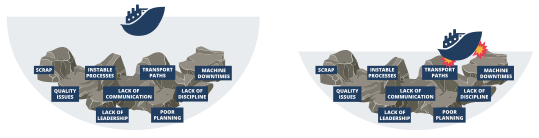
Existing obstacles are hidden by the high water level (overproduction and stocks).
Problems become apparent as soon as the water level drops.
A slow reduction in overproduction/inventories reveals problems that must be resolved to maintain production.
Why do you do this? Because you don’t want waste in your processes. Waste doesn’t decrease when you work longer—it tends to increase. We should ask ourselves whether the waste you encounter in your current workflows has already reached its minimum. Because you’ll certainly remember: There are types of waste that are inherent in the system, and yet they should be kept as small as possible.
You notice, my dear readers, we are still (!) facing the problems that were described to us back in the 1990s by the two bestselling authors J.P. Womack and D.T. Jones. In their book “Lean Thinking: Shedding Ballast, Increasing Corporate Profits,” they explain the value stream in which the “3Ms” should be reduced to a minimum: overproduction (Muda), asynchronous (work) processes (Mura), and overload (Muri).
So, increasing efficiency remains the focus. This is already complicated enough, as TPS has often been misunderstood and misinterpreted over the past few decades. I address this problem in my podcast “Moden im Management.” Perhaps you’ll give it a listen?
As long as you don’t have an overview of the level of waste in your processes, it’s pointless to fret about the threat of longer working hours. It’s legitimate to ask whether efficiency has suffered in recent years and what the causes are.
Finding out doesn’t require complex analysis technology. If it has, then this may be an indication that your process landscape has become too complicated, and a call to simplify it again is made. Data is simply not – as is often claimed – the “new oil.” This comparison is flawed. Oil was in the ground long before humans existed.
Data, on the other hand, we created ourselves and continue to do so. Perhaps this is one reason why we’ve lost track of things. Therefore, please note: Before you try to explain reality to yourself with complex algorithms, remember the law of “5G”: the true place (genba), the true object (gembutsu), the true facts (genjitsu), the theory (genri), and the standards (gensoku). You usually don’t find these (initially) with the help of IT, but rather where value creation takes place – in production.
Complexity is not destiny. We have simply allowed many processes to become complicated, and therefore require complex analysis methods. If the analysis becomes too complex, this can be a sign of “overprocessing,” i.e., an inappropriate method that misses the target. This includes organizational structures that create double reporting relationships, as well as material flows in which the value stream must be laboriously “managed” because it is regularly interrupted.
Therefore, I would like to encourage you: Don’t let discussions about working hours confuse you. One of the oldest methods in the field of ergonomics still holds its own today. Lean thinking is more relevant than ever. The TPS methodology, in particular, encourages you to organize work in a resource-efficient and simple manner – precisely to ensure that problem-solving remains possible. The mentee is the focus, and the mentor challenges and supports them.
If you start here, then your evenings will also be a success, and the anxiety about longer working hours will subside.
sources
1.) Daniel Zwick, WELT, 15.05.2025, Friedrich Merz: Mit 4-Tage-Woche und Work-Life-Balance können wir den Wohlstand nicht erhalten
2.) Lotte Laloire, taz, 19.05.2025, Arbeitszeit in Deutschland
3.) James P. Womack, Daniel T. Jones: Lean Thinking. 3., erw. und aktualisierte Auflage, Frankfurt 2013, S. 323

‘Working more’ won’t get us anywhere in Germany. We should think about ‘performance’ again before we get upset about longer working hours. If we want performance, then the first thing we have to do is eliminate everything the customer doesn’t want to pay for.FRANK KRAUSE
Senior Partner – Staufen, part of Accenture
Order magazine
Our magazine focuses on success stories that show how companies are addressing these challenges in order to remain competitive in their market environment. Our articles are written by customers, partners, and colleagues who share their practical experiences with us.

You may also be interested in:

Is complexity our destiny?

Methology and Method

Labor value theory: stumbling block for lean processes, protection for the planet
REQUEST THE MAGAZINE NOW AS A DIGITAL VERSION OR PRINT EDITION
